
People Analytics Maturity
Where do you stand? Does it even matter?

Learn People Analytics in a Practical Way!

👉 Check out my new Practical People Analytics Course that covers the most common questions I get from HR professionals:
What metrics should I use?
How do I measure engagement?
How do I make sure there is no bias in my comp?
What is the best way to measure performance?
How can I use advanced analytics to drive action?
Which means… you will have everything you need to build your data-driven HR function.
Now, onto the letter!
Hi, Friends,
Welcome back to my newsletter!
So!
The other day, someone asked me about the maturity models out there for people analytics.
My mind immediately went back to my past at Deloitte and all of Josh Bersin Maturity models we used to love and use in client engagements.
Not so fast, I said to myself.
Perhaps those are outdated? No longer relevant? Or, simply wrong.

After all, it has been a few years since I have used one in my work (more on that later).
In this post, I am writing about maturity in People Analytics at 4 levels.
Level 1: Operational Reporting
Level 2: Advanced Reporting
Level 3: Advanced Analytics
Level 4: Predictive Analytics
And later, we will talk about the value of the levels overall.
But first—let’s get into it.
Level 1: Operational Reporting - Laying the Foundations

Why don’t we create a structure for each one of the levels? Propose we go with: the why, tools, and assessment questions.
WHY:
To understand where we stand in the business
This includes four fundamental areas:
Hiring: How quickly are people coming into the business?
Attrition: How quickly are they leaving the business?
Engagement: Are they engaged?
Productivity: How much revenue do they generate?
These areas each represent the metrics the board wants to see to understand the viability of any business. If any of these metrics are out of whack, you are dealing with an unhealthy business and must think twice about investing.
TOOLS:
For the most part, you only need simple tools to be successful at this stage
A simple spreadsheet will do (and does well) at this stage of maturity
Most organizations start with finance measuring and reporting on these metrics
More advanced organizations have dashboards
ASSESSMENT QUESTIONS:
To what extent does your organization regularly track and report on key people metrics, such as turnover rates, time-to-fill vacancies, and performance?
How would you rate the effectiveness of your organization's use of spreadsheets for reporting people metrics?
How would you rate the effectiveness of your organization's dashboards for reporting people metrics?
To what extent do the insights derived from operational reporting influence decision-making processes within your organization?
Level 2: Advanced Reporting - Unveiling Patterns and Secrets
WHY:
This area of reporting goes beyond simple metrics
We start looking deeper under the hood to understand what the organization looks like from a more multidimensional perspective
You start looking into representation here
Productivity
Compensation
And other metrics that give you a good visualization of what the firm looks like
TOOLS:
Here we start with, guess what, spreadsheets

Again, most of the analyses in reporting can be done with spreadsheets
However, now we also start looking into things like dashboards
And not just dashboards
Dashboards that update in real-time and continuously provide us with granularity. We need to understand the operational aspects of the business better.
You also want to build in at least some automation at this step: otherwise, the data pull would be unruly!

ASSESSMENT QUESTIONS:
Does your organization use advanced reporting practices to analyze compensation, productivity, and diversity?
How well does your organization leverage automation to enhance reporting capabilities?
How well does your organization leverage interactive dashboards to enhance reporting capabilities?
To what extent are the insights derived from advanced reporting shared with relevant stakeholders to drive informed decision-making?
Level 3: Advanced Analytics - Embracing the Power of Science
WHY:
Here, we are moving away from basic metrics
And going a full-on science route
The goal is no longer to report but identify patterns to inform talent strategy
This stage includes running regression models to understand what drives employee behaviour and motivation
Which operational characteristics result in positive outcomes
And also, how can cluster employees using statistical models to deliver the best employee and business experience
TOOLS:
Science
Okay, Okay… I am just kidding
Data Science
We are talking about statistical modelling, including regression and machine-learning techniques
You will 100% need to know R or Python to run the analyses quickly and effectively, and you better have a data scientist on your people analytics team right about now
ASSESSMENT QUESTIONS:
How proficient is your organization in using statistical modelling software (e.g., Python, R) to analyze complex people-related data?
How proficient is your organization in using statistical modelling techniques (e.g., regression, machine learning) to analyze complex people-related data?
To what extent does your organization explore the factors influencing employee attrition, compensation impact, career development opportunities, and manager-employee relationships using analytics?
How effectively does your organization utilize advanced analytics to gain actionable insights that enhance talent management strategies?
How well can your team explain the data results to other parts of the business?
Level 4: Predictive Analytics - Glimpsing into the Future
WHY:
The holy grail of people analytics is the ability to predict the future
And, no, we are not relying on the signs or connecting with our relatives here via the crystal ball

I am talking about asking out models to make an educated guess based on the data we have today

TOOLS:
The greatest tool here is understanding the past as past behaviour predicts current behaviour predicts future behaviour
It is also about using models that engage with time and reduce uncertainty
The thing about the future is that you cannot see it, and it is constantly changing
So, you have to be able to make the best guess about what will happen and then model the likely accuracy of your guess (and error)
Again, you will need Python and R here, some forecasting model knowledge, and certainly a time series analysis
But most of all, you will need to have your head here as you would have to make a bet on the accuracy of the models
This is where the game becomes much more about art than it is about science alone
ASSESSMENT QUESTIONS:
How proficient is your organization in using advanced statistical techniques, regression models, forecasting models, and machine learning algorithms for predictive analytics?
To what extent does your organization use predictive analytics to forecast high-potential employees, employee performance, and workforce demand?
How effectively does your organization leverage historical data to make data-driven predictions and take proactive measures?
How willing is your organization to make bets using well-defined insights with a limited level of certainty?
But, Remember…
Maturity is non-linear.
You can be more mature in one area versus another.
So, perhaps, we should switch how we think about it all:
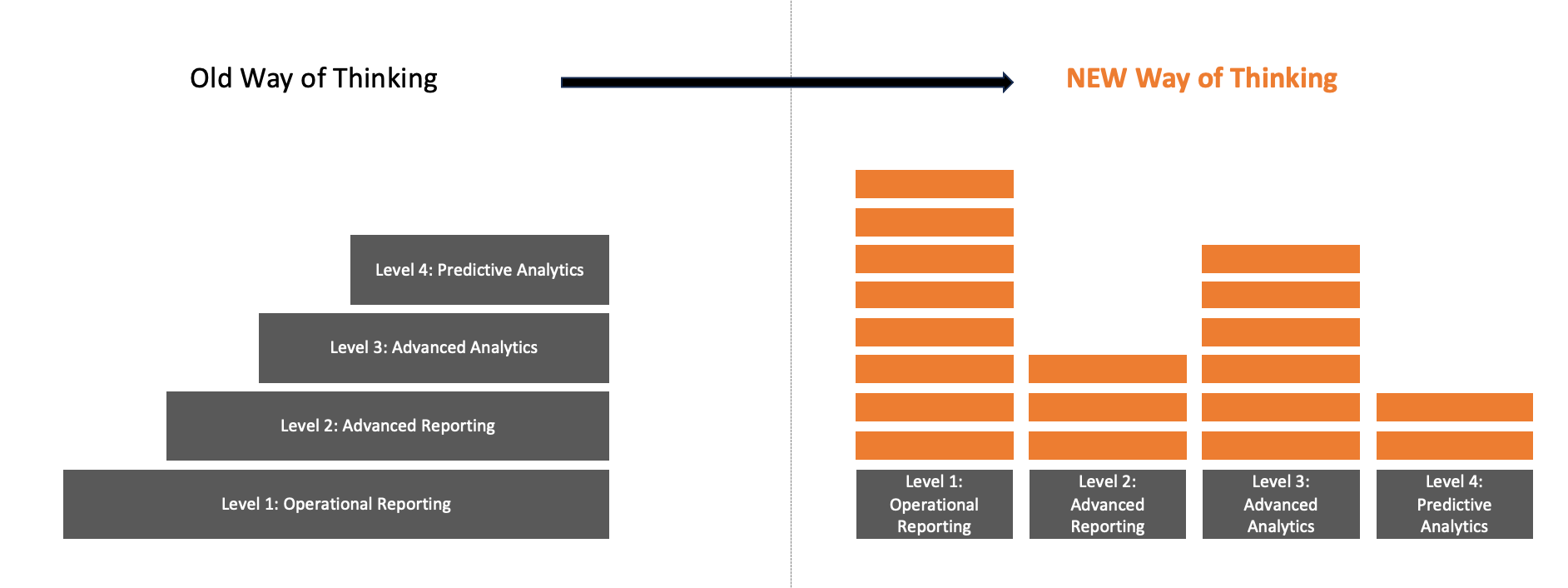
There are cases where you might have people doing some very fancy people analytics, all while no one really provides consistent reports on the basic HR metrics.
Sure, it’s rare. It’s uncommon. But, it is not beyond the realm of the possible.
Hence why…
I rarely care about maturity models at all.
To me, what is important is are you answering your business why with analytics.
And though I know some people will hate me for saying this. But People Analytics is not the area of the business — it is a tool to deliver the outcomes every business is looking for.
Learn People Analytics in a Practical Way!
👉 Check out my new Practical People Analytics Course that covers the most common questions I get from HR professionals:
What metrics should I use?
How do I measure engagement?
How do I make sure there is no bias in my comp?
What is the best way to measure performance?
How can I use advanced analytics to drive action?
Which means… you will have everything you need to build your data-driven HR function.