
People Strategy 2024:
Review & Lessons Learned in Numbers

HAPPY NEW YEAR!
Can you imagine, just a few days ago, it was still 2023?
And now, we are already on Day #3 of 2024. I don't know about you, but I feel bullish on the year. It will be a good one for businesses, markets, and individuals!
And here is a proof that the year is off to a good start:
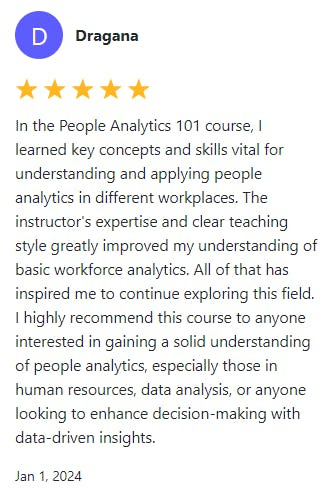
This is another positive review of my People Analytics course, but this time, it goes to the FREE People Analytics 101 Blueprint.
I love receiving this love for the products I create, as it reminds me I am doing something helpful!
Speaking of helpful...
Today, I finally read the State of People Strategy Report 2024. Thanks, Lattice!
Ultimately, the report examined the current state in 2023 and the road ahead into 2024, including:
How did HR do in 2023 overall?
What went well, and where do we have an opportunity?
And, finally, what should we focus on for 2024?
I am ready to dive in, are you?
How did we do in 2023?
Let's be frank: 2023 was a rough year for HR.
More layoffs. Interest rate hikes. Continued economic fears and declining consumer and employee sentiment. The start of the AI revolution. Israel-Hamas war. Pay Transparency Laws going into effect.
And all of this, on top of the previous years of the global pandemic, more interest rate hikes, recession fears, remote work, and the Russia-Ukraine war. And more layoffs.
HR has not had a moment to slow down, and I think we are seeing the signs of it in the data:
More than half of respondents had to lay off staff in 2023
67% of organizations saw low morale
65% of HR professionals feel confident about job security
Only 11% of HR professionals said they exceeded their goals
Over half admit they fell short of their goals
Eek.
The truth is HR is working hard. I think we are working harder than ever. Yet, you can only do so much by working hard in light of the global change, flat headcount, and resources you are given.
Sure, you can burn the midnight oil.
But how many nights do you have until the oli burns out?
Looking at the data, I have to say that we've had better years in HR. I hope 2024 will bring more positivity for us.
What went well?
Okay, so not everyone had a challenging year. Several organizations outperformed the rest. Or, at least, they felt like they did.
And the biggest question is:
What makes them different?
If we uncover the answer, we must replicate their success in our organizations!

It's as simple as that, right?
For one, the top performers are confident in their impact:
81% believe they have an effect on Product/Service Quality
85% on Customer Satisfaction
75% on Revenue Growth
81% on Company Costs
They can demonstrate the link between HR and business outcomes at 82% versus only 40% of low performers.
Booyah!
On top of that, they have a firm HR budget for the year, and the C-Suite values employee experience and the work HR does.
So, we are once again faced with the same old desire of HR to be a strategic partner to the business:
HR teams that become strategic business partners outperform the ones that do not.
So, what is stopping other HR teams?
It might just be my opinion, but we are still struggling in the legacy world of HR, where the focus is no rules, regulations, and employee relations.
Don't get me wrong, these things are essential, but none screams strategic partner.
Here are a few examples where HR can be strategic:
How do we structure our company to go to market successfully?
How do we identify differentiated talent in the market and make our organization irresistible?
What training leads our salespeople to sell more widgets and increase customer satisfaction rates?
But do notice that these are crucially dependent on the linkage between HR activity and outcomes. And this, to me, is all about numbers:
Organizational Design diagnostics to optimize productivity and delivery of the core products
Selection Assessment's ability to hire talent that onboards quickly and delivers on the revenue outcomes
The training targeted specific capabilities that lead to consistently successful sales (and happy customers)
Or even, how much exactly does productivity go up with increased engagement?
These are the numbers executive teams want to see. But these are not the numbers HR teams readily provide.
Once HR starts linking closely with business outcomes, I believe they will see more support from the C-level executives, including resources and sponsorship.
I hypothesize that the C-level does not see the value that HR brings to the table in most organizations.
So... Why don't we show them?
In 2024: Consider how you will connect HR programs to business outcomes.
HR Focus 2024
According to the survey, we see Engagement, Performance, and Manager Enablement in the 3 top spots as priorities for the future.
This all makes sense, considering the year of efficiency and the overall negative sentiment in the workforce.
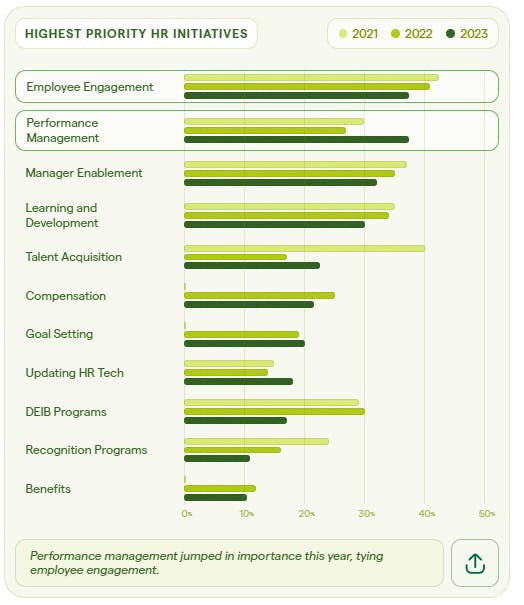
However, reading the graph, I noticed that Engagement always comes out first.
Why is that?
I guess that's because we can successfully measure engagement; we used this as a metric to show our executive teams.
With expectations changing and C-Suite focusing more on performance, we see that Performance also emerges.
Manager effectiveness comes out 3rd because the C-Suite noticed that not many managers use consistent practices in their people management and gave an assignment to HR.
So, this graph tells me that we know what is important for us to do in 2024: focus on the impact of HR on business performance.
Solve this equation and reap the benefits.
Easier said than done, you might say. And it is true!
There are no shortcuts:
We need to start measuring performance
Next, we need to measure HR programs
And then, on top of that, we need to correlate the two
While avoiding bias and other statistical artifacts
But you gotta start somewhere.
Will you spend another year trying to chase the rabbit?
Or, will you lean into data-driven HR to be strategic?
If it's the latter, I'm happy to help.
If the former, I hope to convince you soon.
K
Whenever you're ready, there are 2 ways I can help you:
#1
If you're still looking to get started in People Analytics, I recommend starting with my affordable course:
Practical People Analytics: Build data-driven HR programs to 10x your professional effectiveness, business impact, and career. This comprehensive course will teach you everything from building an HR dashboard for business results to driving growth through more advanced analytics (i.e., regression). Join your peers today!

#2
If you are looking for support in your human capital programs, such as engagement, retention, and compensation & benefits, and want to take a more data-driven approach, contact me at Tskhay & Associates for consulting services. Or simply reply to this email!