
Predicting the Future
What Do We Really Mean?

Hi again, Friends,
This week, I did not know what I should write about, so I went on LinkedIn to find this interesting post by Hallie Bregman:
Of course, she talked about trends and skills and how to use this information internally to drive outcomes.
But, I wanted to muse about the FUTURE more generally. Specifically. around this notion of prediction we all talk about in People Analytics.
So, in this issue:
What we mean by predictive models
Why are we not actually predicting the future
And, of course, can we even trust the predictions?!
Shall we?
What do we mean by predictive model?
In people analytics, we love to try to predict what will happen next. But if you have ever attempted to predict anything, you must realize it's pretty darn hard.
The typical tool used is a variation of a simple regression model, where the outcome Y is a function of independent variables (X) and a random error (e).
It looks something like this:
y ~ b0 + bx + error
Yes, you guessed it, a simple equation of the line with some variability around the estimate!

Here are a few questions you can try to answer with this simple form:
A typical employee will be more satisfied if they had X number of hours working on their career with their manager
Quota attainment is a function of the recruit's influence capability
Compensation is a function of the performance and role level of the individual
We try to extrapolate our models into the future.
In reality, these models simply make a guess (prediction) about what one score might be in a dataset as a function of another score.
So, this is what we call prediction:
If a person spends 5 hours with their manager on career development, they will likely respond 9 on an eNPS question in the dataset
Influence capability of 6 predicts an additional 20% attainment in sales for a new recruit in the dataset
Or, higher performers enjoy a 6% increase in the dataset
It seems fairly straight to the point. However, these models never produce a perfect prediction of the future. Why?
Well, because they do not actually predict the future! They are constrained to the dataset.
Wait, what?
Why do these models not predict the future?
The main reason is that these models are cross-sectional and only predict the present using the present past data.
This means your extrapolation that something will happen in the future is based on one strong assumption:
Everything will remain the same at a future point as it was in the dataset.
And we know that is not the case.

In fact, only over the last few years have we seen changes to our global approach to work due to the pandemic, changes to the funding models due to the changes in economic conditions (interest rates), and changes in sentiment related to wars around the globe.
And with these Black Swan events, our model loses its accuracy:
The employees now spend time with their manager under different circumstances (Zoom?)
Influence becomes less important than listening as a capability
We don't even have the funds to provide increases to anyone at the company
Simply stated, things change dramatically after we run the model.
What is more important to remember is that the farther we go into the future, the less we know what will happen.
Just take a look at the outcomes over time for 2020 in blue:
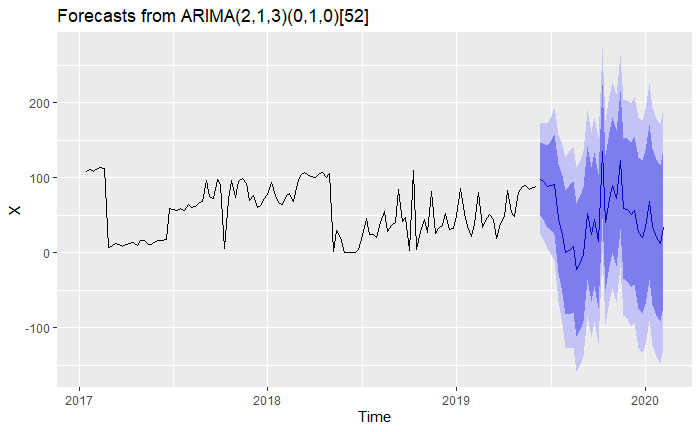
In essence, though this graph told us that we normally range between 0 and 100, the ARIMA (one of the most prominent and well-known forecasting models) created a prediction between -150 and 200.
I don't know what they were predicting here, but this simple demonstration shows how broad the outcomes become when using math to extrapolate something into the unknown.
So, can we trust the prediction in people analytics?
The answer is yes, but with a caveat.
Sure, you can see the broad outcomes and recognize that the events out there changed the circumstances under which the initial model produced the results.
But you have to bet on something when making decisions.
And sometimes, a model producing a decent but imperfect accuracy will be better than no model at all.
People analytics is not about you running models. It's about using the information from your model to come to the most likely conclusions.
So, in a way, it is an art and a science.
See you next week, ciao!
K
Whenever you're ready, there are two ways I can help you:
#1
If you're still looking to get started in People Analytics, I recommend starting with my affordable course:
Practical People Analytics: Build data-driven HR programs to 10x your professional effectiveness, business impact, and career. This comprehensive course will teach you everything from building an HR dashboard for business results to driving growth through more advanced analytics (i.e., regression). Join your peers today!

#2
If you are looking for support in your human capital programs, such as engagement, retention, and compensation & benefits, and want to take a more data-driven approach, contact me at Tskhay & Associates for consulting services. Or simply reply to this email!