
Skills Revolution?
What is it anyways?

If you are in HR or People Analytics like me, you probably hear the term “skills revolution” all the time.
It’s in all the reports, all the calls, and all over LinkedIn.
Yet, if you are like me, you must feel that it is not a super practical topic of discussion: mostly pompous words and hand-waving: “Beware, the skills revolution is coming!”
Is it, though?
I asked the question on LinkedIn about it and got some responses from some very intelligent people. (this post did not get many likes, but had some really interesting comments from the heavy hitters in the field).

But more importantly, I stopped to think.
What the heck is skills revolution anyways?
Interested?
Follow along…
1. What are jobs?
We talk about jobs all the time. What we mean here is easy. We mean a job someone has. A job to be done. Work. Tasks.
These are the things we need to get done.
Regardless of where you are in the organization, you need to do work to produce the outcome:
a cog in the machine,
a delighted customer,
a negotiated contract, or even
writing a report about the skills revolution.
It is energy to create something that is monetizable for the business. Let’s be honest: if your work is not generating dollars (even down the line), there is a bigger issue with an organizational design.

Next, we can break down work into task units: the smallest units of work that need to be done.
Here you have things like
running a machine to make cogs
speaking to a disgruntled customer
reviewing contracts
or writing.
Each job is a composition of tasks that need to be done to achieve job outcomes.
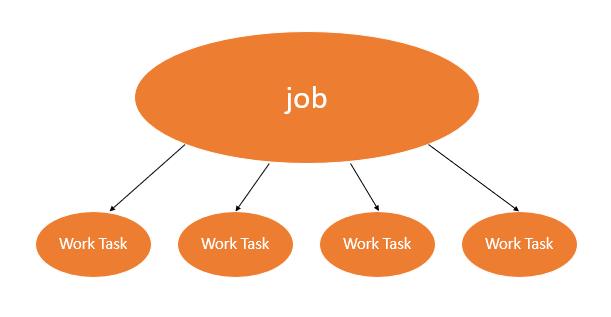
So far, so good.
Going a step further, what is a skill?
2. Skills is how the work gets done.
Or more so, proficiency in delivering the work precisely as it needs to be done.
Take writing, for example.
It is a skill. We all know how to do it as we learn it early in life.
Yet, some of us are better writers than others.
Part of it is talent, of course, and natural predisposition.
But a considerable part of writing is in practice:
The more you write, the better you get at it.
You are building a skill.

So, in other words, our proficiency in doing the work that needs to be done within a job that needs to be done within a larger organization is at the core of our skills.
Skills and work are a jigsaw puzzle, lock and key, or whatever analogy you use.
3. Skills and work are all about fit.
If jobs are compositions of work, then individuals doing the job need to have a composition of skills to deliver the right outcomes.
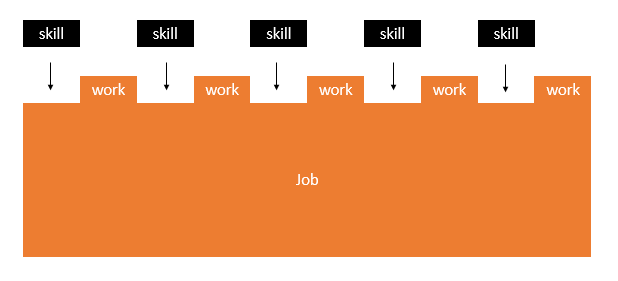
When the two fit together well, you create business value.
When two don’t fit, you are less likely to be able to deliver business value.
In fact, if all the hiring data are correct, you don’t even need all the skills to deliver the job. Think of job descriptions with a wall of text where you only need 1 or 2 elements to stand out in the interview.
4. That’s because some skills are more important than others.
This is where the skills revolution comes from.
The world is changing rapidly with the emergence of new technologies and approaches to work. Things like People Analytics did not even exist to the same extent 10 years ago. And ChatGPT and AI technology will seriously disrupt the world of work.
And not many people have these skills.
Hence, these skills take the center:
We want to develop them
Our firms want us to develop them
Our businesses want us to buy them
Therefore, you have a phenomenon of “skills revolution.”
But it really is no revolution at all.
It is us asking for skills in short supply in the market, with an increased focus on obtaining those skills to do the jobs we need to get done.
It’s a supply and demand problem!

5. A skill on its own is not super useful.
Okay, you know how to run a regression model.
That is a scarce skill in HR and in People Analytics.
And regression modelling can produce fascinating insights into what levers to pull to address your retention, engagement, and talent acquisition.
Yet, this same skill on its own is useless.
Here is a regression output:
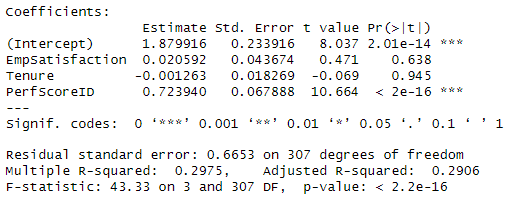
The problem is that you need other skills to interpret it properly!
Business acumen to know if you even need to run a regression
Data preparation to aggregate and clean the data
Statistics to check for any assumptions
Data Storytelling to communicate the data
And note that having any of these on its own will not get the job done.
Sure, you can hire a person for each; but that would not be the most economical solution.
Hence, jobs are compositions of work.
And jobs also compositions of skills that deliver work.
To tell you the truth, after writing this post, I don’t think we are having a revolution. Mostly hype about the skills supply and demand problem in the market.
Tell me what you all think, however!
Cheers,
K
Learn People Analytics in a Practical Way!

Check out my new Practical People Analytics Course that covers the most common questions I get from HR professionals:
What metrics should I use?
How do I measure engagement?
How do I make sure there is no bias in my comp?
What is the best way to measure performance?
How can I use advanced analytics to drive action?
Which means… you will have everything you need to build your data-driven HR function.