
Wellness Analytics:
What to measure and how

Hi, Friends,
2 weeks ago, I hosted the first People Analytics meet-up in Toronto. And it was a blast:
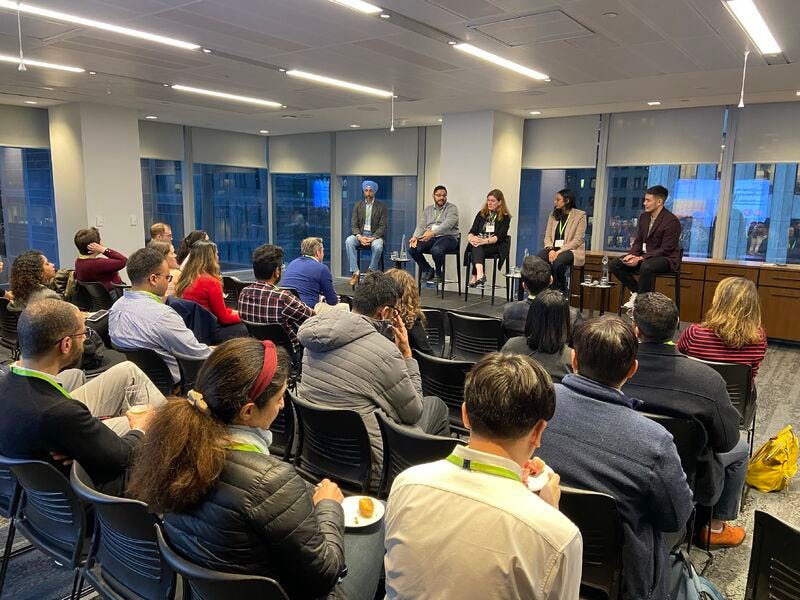
I got into an interesting conversation there:
How do you measure employee wellness
And, how do you measure happiness
Stop!
Now, reread this last sentence.
Yes, we are still discussing the fundamental question of every philosophy:

So, in today's issue:
We will define happiness
Consider the difference between happiness and wellness
Focus on creating strong wellness programs at work
Let's go!
Happiness, what is it?
That's a hard question.
We need to go back to the basics. Definitions.
According to Merriam-Webster, happiness is a state of well-being and contentment.
Okay, now, what is well-being and contentment?
Well-being is the state of being happy, healthy, or prosperous.
Contentment is the quality or state of being contented (feeling or showing satisfaction with one's possessions, status, or situation).
What are we getting out of these definitions:
Happiness is a state, not a trait. Like water, happiness can change depending on the situation.
Happiness is individual: Like the definition of health, prosperity, and status, all are relative, and hence, it's about where the person draws the line.
Happiness is in possession: People perceive happiness when they have things, states, or satisfaction, not focusing on the absence of things. In other words, we want to be healthy, not absent of ills.
Given this, there is no better question to find out how happy someone is than to ask:
On a scale from 1 to 10, how happy are you?

Sure, this measure is simplistic, but it touches on all parts of the definition:
it asks people at the moment (state)
for their own definition of happiness (individual)
and their perception of having happiness (possession).
But should we measure it at work?
The answer is no.
Happiness versus Wellness
Why wouldn't you measure happiness at work?
The answer is simple:
You cannot control it
Everyone has a different definition
Work represents only a minor part of overall happiness
Imagine walking into work after a breakup, an accident, or even when you hit every traffic light on the way there. These things affect your happiness before you even step into the office.
So, happiness is difficult for an employer to control.
Second, it is not the company's job to make people happy.
The job is to drive revenue and productivity. If happiness happens to drive better outcomes, it's about creating an environment where people are more likely to feel favourable than negative.
And let me tell you a well-known secret: happy employees actually do drive more revenue.

But know this:
You cannot make people happy or unhappy
But... You can create an environment that is conducive to happiness
And that is where the wellness comes in:
Do people derive meaning from their job
Subjectively
Monetarily
Are people expanding their horizon
By learning new skills
Tackling new problems
Are people around them behaving
Decently
Productively
All of these you can measure contribute to how people feel about wellness at work.
You cannot control happiness, but you can control wellness.
Hence, you need to create strong wellness programs.
First, you must take care of your compensation and benefits.
Although we like to say that your salary and income do not determine your worth as a human, this is not how most people see it in a capitalistic society.
In fact, one of the first questions we get in North America is, "What do you do? What's your background?"
So, provide the compensation and benefits people see as fair, reasonable, and even delightful.
Measure satisfaction with compensation and benefits
"I am satisfied with my compensation"
"I am satisfied with my benefits"
I know: most people are not satisfied with their compensation. But at least you will get some variance around a lower mean here.
Second, focus on the work structure.
Here, it is less about what people do, I find...
Usually, when people talk about work challenges, they are talking about two things:
Someone is blocking them from doing work (communication)
Someone is pushing paper around (efficiency)
In both situations, your employees are telling you that you need to review and optimize your organizational design. This means creating clear expectations at work and removing barriers, redundancy, and inefficiency that do not lead to outcomes.
All you have to do is quantify these analytics and follow them.
Third, you have to focus on career growth.
Is this role helping me advance in the title and the types of problems I am solving? Do I feel challenged at work, or am I just doing the same thing over and over to boredom?
And guess what?
Most employees will not raise their hands and ask for more challenges and promotions.
Why is that?
Simple: We are not taught to do this.
The entire school format takes control out of the individual's hands and gives it to the teachers. Hence, most people wait to be promoted or to be given an exciting assignment. Notice the passive tone here.
To change that, why not ask them what their career aspirations are?
And then create an environment where these career aspirations can flourish.
You probably noticed that all of the aspects of wellness are the same as those that make work work. I did not discuss mental health benefits, gym memberships, etc.
That's because I don't think any of these create consistent wellness at work. They are great to have (don't get me wrong), but these benefits rarely have a more significant impact than actually having a great day at work. If you want your employees to be happy, you must address their work experience daily.
I'm on vacation next week, so... I might take a break from writing this newsletter for the first time ever. But we shall see.!
Cheers!
K
Whenever you’re ready, there are 2 ways I can help you:
#1
If you’re still looking to get started in People Analytics, I recommend starting with my affordable course:
Practical People Analytics: Build data-driven HR programs to 10x your professional effectiveness, business impact, and career. This comprehensive course will teach you everything from building an HR dashboard for business results to driving growth through more advanced analytics (i.e., regression). Join your peers today!

#2
If you are looking for support in your human capital programs, such as engagement, retention, and compensation & benefits, and want to take a more data-driven approach, contact me at Tskhay & Associates for consulting services. Or simply reply to this email!
very factual definition of happiness at work, Konstantin! I really like it.
Enjoy your well deserved holidays! Where are you heading?